 DuckLocal
DuckDB 2.0, codenamed Cyanoptera, is scheduled for October 21, 2026. Just seven months after the 1.5 release in March, the project has accumulated more than 10,000 commits.
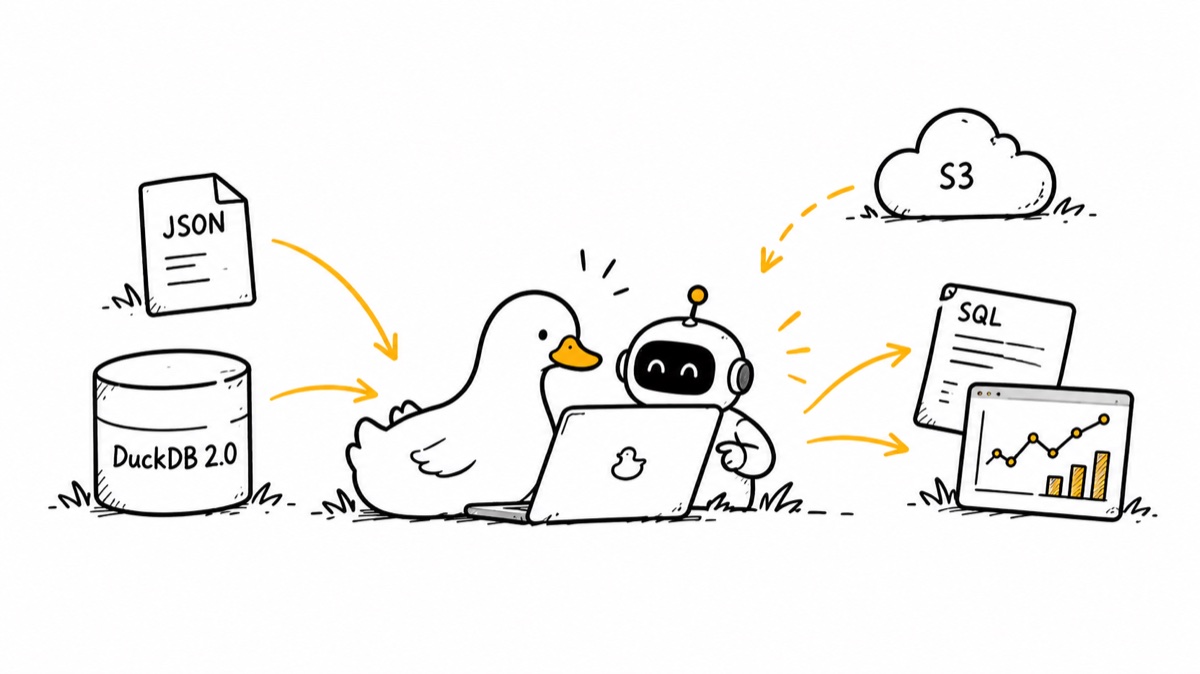
The new version brings a new storage format, SQL parser, asynchronous I/O and more complete VARIANT support, alongside server mode and a CLI Agent Mode designed for AI agents. To me, the interesting story goes beyond how much faster an individual query runs: DuckDB is changing what a data analysis tool can look like.
I have spent much of my career working in SRE, observability and security analytics. More recently, I have been building DuckLocal, an open-source, local-first analytics tool powered by DuckDB. I increasingly see a future in which analysis is a collaboration between people and AI agents, rather than a person opening a BI tool to write SQL and configure dashboards. Several changes in DuckDB 2.0 fit that direction.
1. Agent Mode: treating agents as database users
Traditional command-line interfaces are designed for people. The borders and alignment spaces in a DuckDB CLI table are less useful to an agent. Padding consumes tokens; a truncated result can look complete; errors may lack structure; and a long query can leave the agent waiting without useful feedback.
Agent Mode detects environments such as Claude Code and Codex and adjusts the output automatically. It uses compact Markdown tables, explicit truncation notices and JSON errors, and provides feedback for long-running queries.
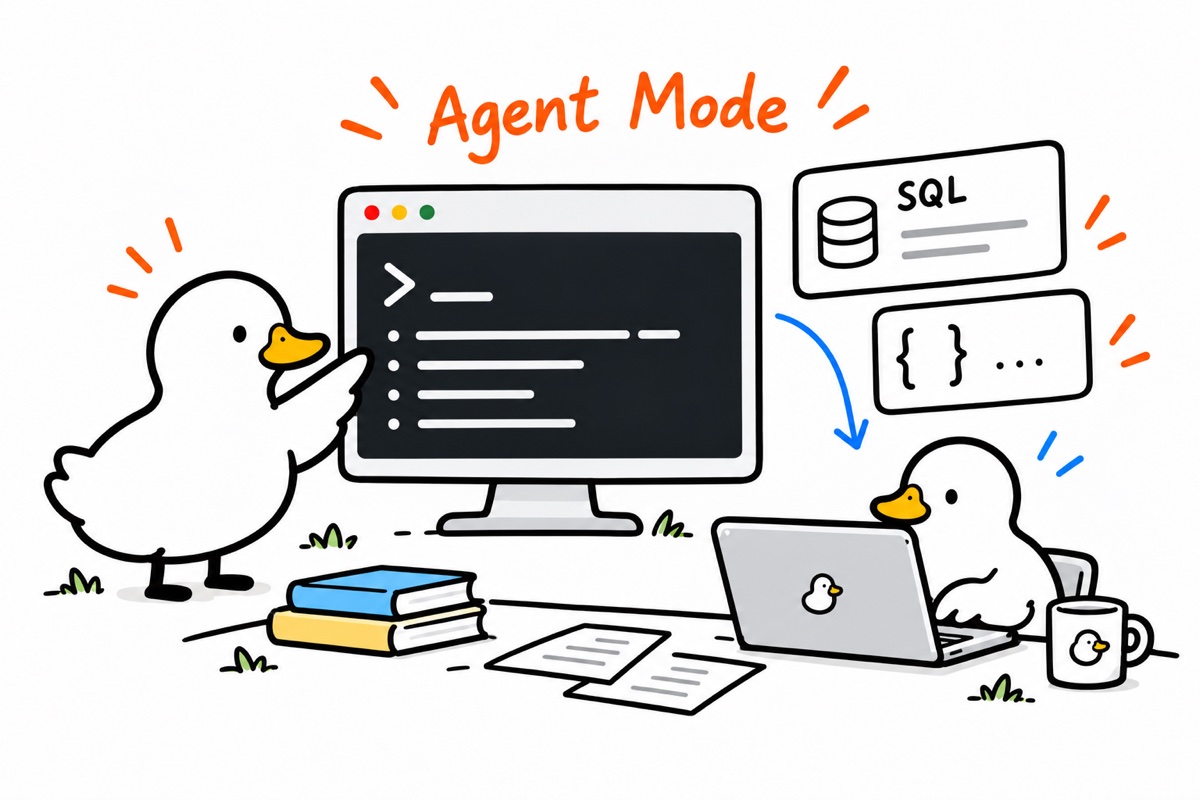
In an official experiment, Claude Code answered all 22 TPC-H questions from natural-language prompts. Each question ran three times in each mode, for 132 runs in total, and every run produced the correct answer. The DuckDB output read by the model fell from 123.6K to 50.8K tokens, a reduction of about 59%. That measures query-output savings, not a 59% reduction in the total task cost. The report puts the savings at roughly 0.5% of total input and found no reduction in overall cost or runtime. Experiment and explanation
Discussions of agents using databases often focus on text-to-SQL accuracy. How efficiently and reliably an agent can interact with the database matters just as much.
2. VARIANT: flexible data with fewer performance compromises
CloudTrail events, application logs and OpenTelemetry data often arrive as JSON with varying structures. In CloudTrail, for example, the shape of requestParameters can be completely different from one event to another.
There are two familiar approaches: store the records as strings and repeatedly parse them at query time, which is flexible but slow; or define a schema and split the data into columns, which is fast but makes schema evolution more work. VARIANT aims to combine these advantages. It preserves flexible structure while using shredding to separate suitable fields into individual subcolumns. VARIANT arrived in 1.5; version 2.0 extends its support from storage through query execution.
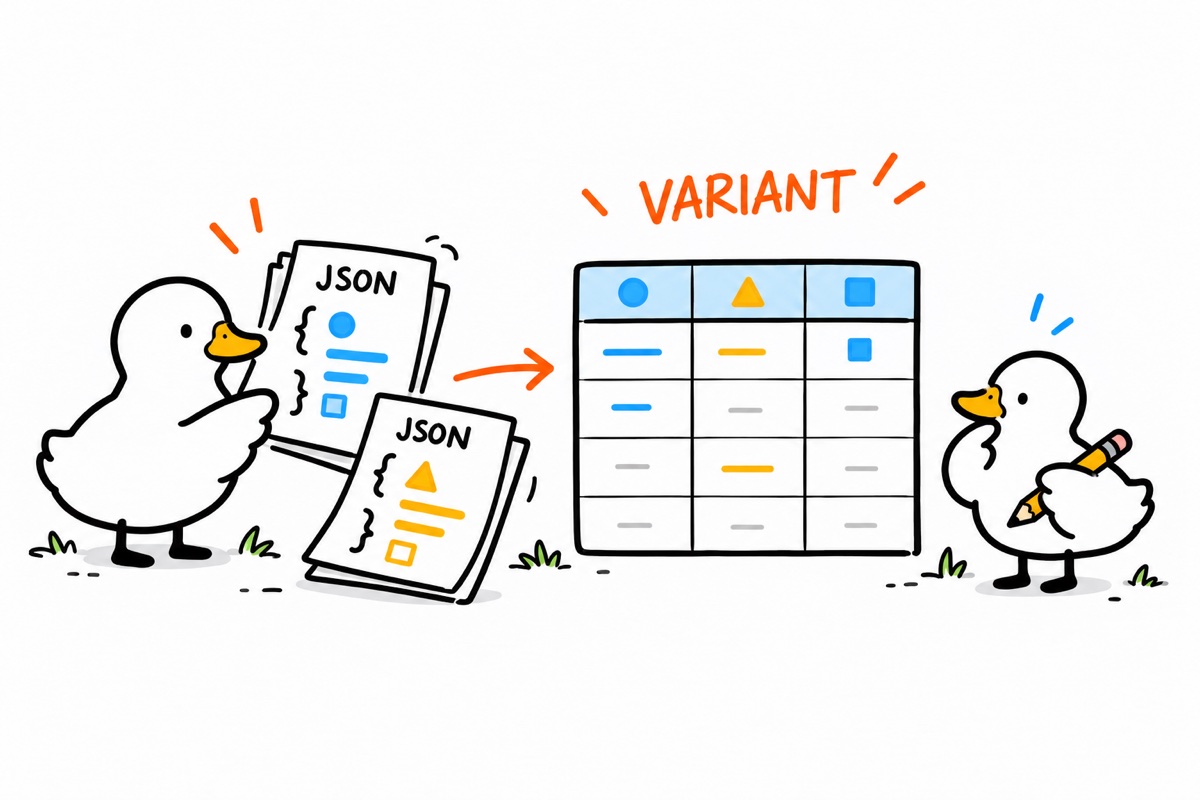
{"eventName":"ConsoleLogin","user":"alice","success":true}
{"eventName":"CreateUser","user":"bob","sourceIP":"10.0.0.8"}
↓ Identify and separate fields during writes
eventName(string) | user(string) | success(boolean) ...
The actual layout depends on the data distribution and encoding.
Some community tests have reported query speedups of around 6×, together with substantially smaller storage. Those numbers depend on the workload.
For security analytics, this opens a path from raw CloudTrail events to user activity analysis, unusual API call detection and permission-change investigations without a complex ETL pipeline. A large data platform is not always the starting point: DuckDB, SQL and an AI agent can support a substantial part of an investigation.
3. Asynchronous I/O: local-first can include remote data
Data often lives in S3, other object stores or a data lake. With synchronous I/O, network latency can hold up remote queries. DuckDB 2.0's asynchronous I/O allows multiple reads to run in the background while query-processing threads work on data that has already arrived.
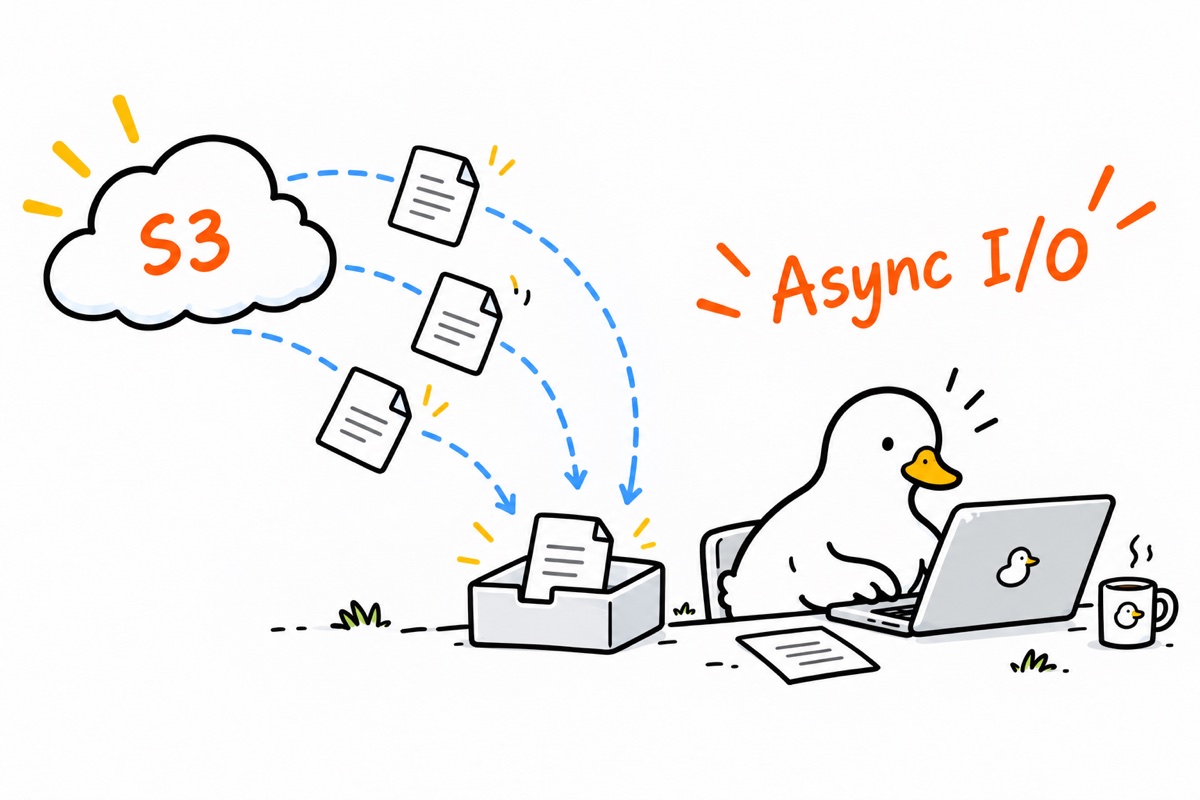
At the time of writing, the I/O documentation lists support for Parquet and uncompressed, seekable UTF-8 CSV files; JSON and DuckDB-native files are still listed as using synchronous I/O. The 2.0 preview article also mentions progress toward native-format support, so check the capabilities of the version you use. I/O documentation
4. DuckDB as a server: beyond a single process
DuckDB started as an in-process database, embedded directly in Python, Rust and C++ applications. That model makes sharing a database across applications or executing queries remotely less convenient. Version 2.0 introduces the Quack protocol and the CONNECT statement, allowing DuckDB to run as a server and clients to send SQL for remote execution. It also supports pushing queries down to remote databases such as PostgreSQL and MySQL instead of bringing the data into the local process.
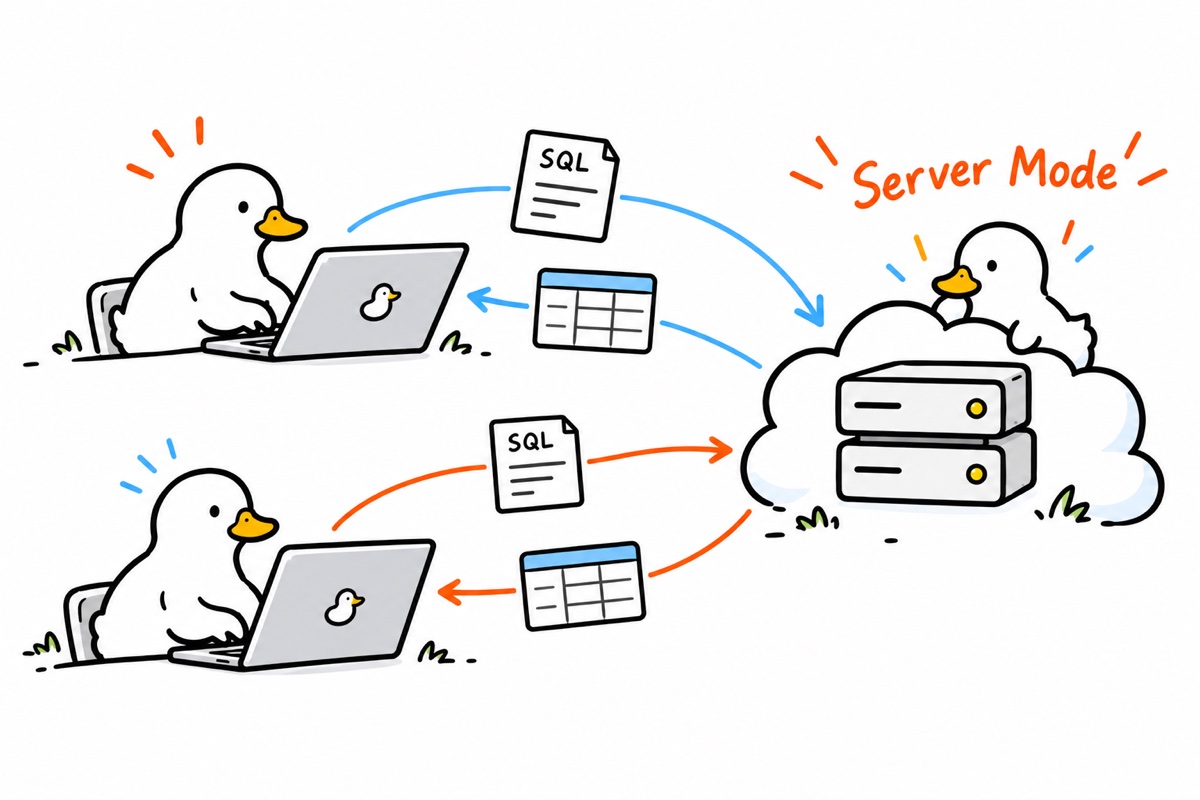
That matters for enterprise use: teams need a shared workspace. The architecture I want brings AI closer to the data, with computation running where the data belongs.
Quack is not, by itself, a complete enterprise solution for permissions, auditing and multi-tenancy. Those still need application-level design. What it provides is a foundation for building that architecture.
Local-first means giving users control over their data and computation. It does not require everything to happen locally.
5. Other improvements worth watching
- A rewritten recursive CTE engine. In a graph-reachability test with one million edges, query time fell from 4.90 seconds to 0.12 seconds, roughly a 40× speedup. Some graph traversal tasks become more practical in SQL, though this does not make DuckDB a replacement for a specialized graph database.
- Native replacements for ICU functionality. DuckDB removes its dependency on the ICU library. In microbenchmarks, time-zone conversion was about 2.2× faster and filtering with a German collation about 2.6× faster. A smaller footprint also benefits embedded applications.
- A stable extension API. A redesigned C API, versioned ABI and support for self-hosted extension repositories could substantially reduce the maintenance needed across DuckDB upgrades. This is especially promising for Rust extension developers.
- Triggers and a PEG parser. Triggers can support auditing and data-change processing. An extensible parser gives extensions deeper access to SQL parsing, potentially opening the door to domain-specific syntax for security analytics and observability.
6. Before upgrading
Version 2.0 is not entirely backward compatible.
- Storage format. Files created or written using the new default format cannot be opened by older versions. If older readers must remain supported, set an explicit storage compatibility version. Existing databases can be exported and imported using the official migration guidance.
- Lambda syntax. The old syntax is disabled by default. A temporary compatibility setting can enable it, but removal is planned for 2.1.
-- Old
SELECT list_transform([1, 2, 3], x -> x + 1);
-- New
SELECT list_transform([1, 2, 3], lambda x : x + 1);
- C++ extensions. Check that compatible builds are available before upgrading.
Validate existing queries, database files and third-party extensions before moving production workloads. Desktop applications should be particularly careful not to migrate a user's file format silently: an older application version may no longer be able to open it. Migration guide
7. Closing thoughts
Analyzing a CSV or a few gigabytes of logs often starts with deploying a database, configuring pipelines and maintaining services. That can make sense for a large enterprise data platform, but it is not always necessary for individual developers, security analysts or one-off investigations.
DuckDB embeds an analytical engine directly in an application. Version 2.0 adds server mode, Agent Mode and a more mature extension ecosystem. The database, AI agent and visual interface can come together as a lightweight, embeddable data analysis workspace.
That is why I am building DuckLocal, an open-source, local-first desktop app for SQL, visual dashboards and collaborative analysis with AI. AI helps explore the data while the user retains control, execution remains inspectable and the SQL stays transparent.
References
As of October 19, 2026, DuckDB 2.0 has not yet been released. The release date and feature details remain subject to the final official announcement.